Showing posts with label Barrier Contracting. Show all posts

Sunday, December 27, 2015

Excavating, Sampling and Disposing of Oil or Gasoline Contaminated Soil

    There are many regulations in New York State (NYS) regarding the removal and disposal of soil that has been contaminated by oil or gasoline.  The regulating agency is the New York State Department of Environmental Conservation.  Information regarding these regulations can be found on their website http://www.dec.ny.gov/.

      If Heating Oil, Diesel Fuel, Kerosene or Gasoline, leaks or spills in the soil, the impacted areas should be excavated and the soil safely disposed of.  If you encounter this you should notify the NYSDEC spill hotline (800) 457-7362 and contact an environmental company, Barrier Contracting, LLC, for advice.  The proper disposal includes collecting soil samples of the impacted soil to be analyzed by a certified lab. The samples can be collected after the soil is excavated and stockpiled or prior to excavation.  The results are then sent to the licensed disposal facility for review. Once approved, the contaminated soil can be loaded and shipped to the disposal facility by a specialized hauler.

     After the contaminated soil has been removed, a consultant or specialized contractor, like Barrier, collects endpoint samples from the four walls and the base.  Again, these samples are sent to a certified lab to be certified.  When sampling, the sampler must also fill out a chain of custody for the sample, these are usually signed by the sampler, transporter and laboratory technician.  These “endpoint” or “post excavation” samples will be used to determine if all of the contamination has been removed. Once, confirmed that the soil is now free of contamination, backfill can be brought in to replace the contaminated soil that has been removed.


    While this seems like a simple process, it is extremely important to hire the right professional to guide you through the process.  There are many companies to choose from in Westchester and Putnam County.  Be sure to ask for references or read reviews (Angie’s list is also a great tool).  Choosing the wrong contractor can add to the time and cost of the clean-up.  The professional must be aware of the regulations and protocols involved with cleaning up oil contamination.  All of the information, analytics, manifests, weight tickets, etc, must be included in a concise report describing the work that transpired and proving the contamination has been properly removed and disposed of.


Saturday, August 1, 2015

Oil Tank Removal and Installation Photos


Bellow are some pictures of the work that Barrier Contracting has done. We remove and install heating oil tanks of all sizes. 


Sunday, February 15, 2015

Helpful tips for buying a home with oil heat.

   When purchasing a home, it is important to know whether the home has or has had an oil tank.  If a “petroleum release” has occurred, it is the responsibility of the property owner to pay for all costs associated with the remediation of the contamination.  As a buyer there are a few things you can do to determine the condition of the tank and the soil around it.  

·       Request any paper work from the town, city or village detailing that the work was done to code.
·       
         Determine if there is or was an oil tank
o   Site visit to perform a field assessment
o   Tile Probe Area Of Concern (AOC)
o   Use Ground Penetrating Radar (GPR)

·       SoilTesting
o   Once the Area Of Concern (AOC) is established, Use soil probing technology to  insert 3 probes to a depth of 6-9 feet
o   Inspect the soil
§  Send the soil to the lab for analysis of Semi-Volatile Organic Compounds (SVOC’s) and Volatile Organic Compounds
o   Compare Lab analytics with the New York State Department of Environmental Conservation Standards
·       
          TankTesting
o   When a tank is found, a NYS licensed tank tester, applies a vacuum to the tank along with an acoustical test.

    The best way to know for sure is to remove the tank prior to closing. Removing the oil tank prior to closing not only shows the buyer you are serious but also relieves you of future remediation costs. 
Old oil tanks can be a costly liability if they leak.  Oil tanks that had previously been decommissioned can also leak if not done properly.

  Some or most new home owner insurance policies do not cover oil tanks and the costs associated with heating oil contamination. This is why it is important to know the condition of the tank and the soil around the tank.  For More information visit www.barrier.com or Call (914)760-2090

Oiltank removal, Consulting, Tank testing, Soil testing

Thursday, December 18, 2014

Oil Tank Removal

Many homes and businesses have oil heat that require large tanks for storage. These tanks can either be found above- or below-ground. While either system is certainly efficient, we have found that above ground tanks pose significant advantages. Oil tanks need to be monitored on a regular basis, and when they are underground, it’s extremely difficult to keep an eye on them. Homes and businesses that have underground tanks aren’t out of luck, however – they can be removed and placed above-ground, which is where we come in!

At Barrier Contracting, we provide underground oil tank removal for homes and businesses. We bring our excavator machine to your location and remove the tank safely and efficiently. Oil tank removal by hand can be extremely dangerous if not done properly. Our specialists are experienced and knowledgeable about the industry’s best practices, and provide excellent service every time. Trust Barrier Contracting for all your needs, from fuel oil storage tank installation to oil tank removal.

The cost to remove underground storage tanks depends on a variety of factors and must be assessed on a case-by-case basis. Our cost-effective solutions are perfect for all of our new and existing clients. Don’t be afraid of any hidden costs. We stand by our pricing and break down each expense to help you understand exactly what you’re paying for. To learn more about our services and get a quote, contact us today by phone or email at (914) 760-2089, (914) 760-2090 or at waynejr@barrier.com

Wednesday, April 16, 2014

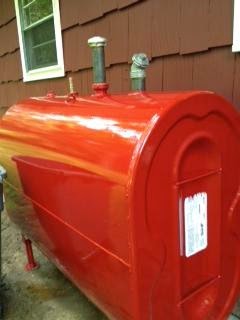
Above Ground Oil Tank Inspection

Above Ground Oil Tanks require very little maintenance. However, it is very important to inspect your tank

It is important for the homeowner to understand
Painted 275 Gallon Above Ground Oil Tank
www.barrier.com
that the oil tank is their property and their responsibility. The tank owner should ensure that it is properly maintained. Proper tank maintenance should include, but is not limited to, the following:

· Subscribing to a maintenance program performed by a heating oil  system licensed service technician;

· Visually inspecting the tank(s) at least Twice a year. Careful visual inspection will uncover traces of oil on the tank surface;

· Asking a service technician to check, at least once a year, for the presence of water inside the tank and to remove it;

· Immediately correct an unstable foundation or when the tank is likely to topple. The services of a licensed installer, Barrier Contracting, should be used;

· Maintaining the tank’s exterior surface, at least once per year, by: 

       1. Gently brushing the rusted areas on the tank’s exterior with sandpaper;

       2. Cleaning the sanded surface; and

       3. Applying a coat of rust proof metallic paint (readily available at
           any hardware store). If needed, Barrier Contracting can provide paint. 

Maintaining the tank’s exterior surface is a good practice and the
application of touch-up paint will not void the warranty of the tank

· Maintaining the tank liquid level as high as possible during the 
summer months to limit water condensation within the tank.

Thursday, April 10, 2014

Information on Failed Oil Tank Tests in New York

Did you know failing a tank test creates a NYS Spill Number?

     If you have failed an oil tank test we recommend replacing the oil tank with an above ground oil tank.  This creates is the best value for the money you will spend.

     When an oil tank fails a tank test, also know as pressure test but is actually a vacuum and acoustical test, the tester must notify the New York State Department of Environmental Conservation (NYSDEC).  Once notified, the NYSDEC will assign your property a Spill Number. A Spill Number is like a case number used to reference your property and the actions taken.  Once the Spill Number is assigned an investigation is required to find out if any soil or groundwater has been impacted and if further action is required.

     This can involve excavating to the top of the tank and checking the fittings, connections and piping.  It can also lead to removing the oil tank, impacted soil, taking samples and sending the NYS DEC documentation of the actions taken.
 
If the breach is in the vent or fill, the top of the tank needs to be exposed and the piping replaced then a retest must be preformed.  If this passes the report needs to be sent to the NYSDEC.

If the breach is in the oil lines, the top of the tank needs to be exposed then the oil lines need to be exposed and replaced. Finally the tank needs to be retested.

If the breach is not found after replacing the vent, fill, oil lines and failing the second test the tank needs to be removed.   After the tank is removed the pit needs to be inspected and sampled. If the samples come back with contamination a remediation must be done.

In the end any single wall underground home heating oil tank should be replaced with an above ground oil tank.  Even if the tank passes a tank test or subsurface analysis. For more information visit www.barrier.com or email waynejr@barrier.com


ARE YOU THINKING OF PURCHASING A HOME WITH A HEATING OIL TANK?

   ARE YOU THINKING OF PURCHASING A HOME WITH A HEATING OIL TANK?

     Find out the age of the tank, some underground tanks can be as old as the house (some above ground tanks are the result of previously replaced underground tanks).  Replacing  below ground oil tanks is the BEST way to verify the tank has not failed and contaminated the property. Your home inspector, lawyer and bank will agree. We recommend to try to get the seller to remove the tank prior to closing 
   
   If no oil tank is present ask if there was a tank previously removed. If so ask for the paper work regarding its removal. Find out why they removed it. If the oil tank was filled in place ask for the results of the soil samples taken. If there were no samples taken, you can have samples taken or at least consult a professional (preferably Barrier). It is best to take sample around the sides and down roughly 2 feet below the bottom of the tank (7-12 feet). For more information visit www.barrier.com or call us today.